Petroleum wax is an important raw material used across a wide range of industrial and manufacturing applications.
From candle production and packaging to rubber, coatings, adhesives, polishes, textiles, and specialty formulations, different types of petroleum wax can provide very different physical and processing characteristics.
For industrial buyers, understanding these differences is important when selecting a wax grade for a specific manufacturing process.
Petroleum Wax: What Is It?
Petroleum wax is a general term for wax materials obtained during petroleum refining.
These waxes consist mainly of hydrocarbon compounds and are typically solid or semi-solid at room temperature.
Their physical properties vary according to factors such as:
- Refining level
- Oil content
- Melting point
- Molecular structure
- Hardness
- Viscosity
- Color
- Processing method
Because of these differences, petroleum wax is not a single product.
Different wax types and grades are designed for different industrial requirements.
Main Types of Petroleum Wax
Several categories of petroleum-derived wax are used commercially.
The most common include:
Paraffin Wax
Paraffin wax is one of the most widely used petroleum waxes.
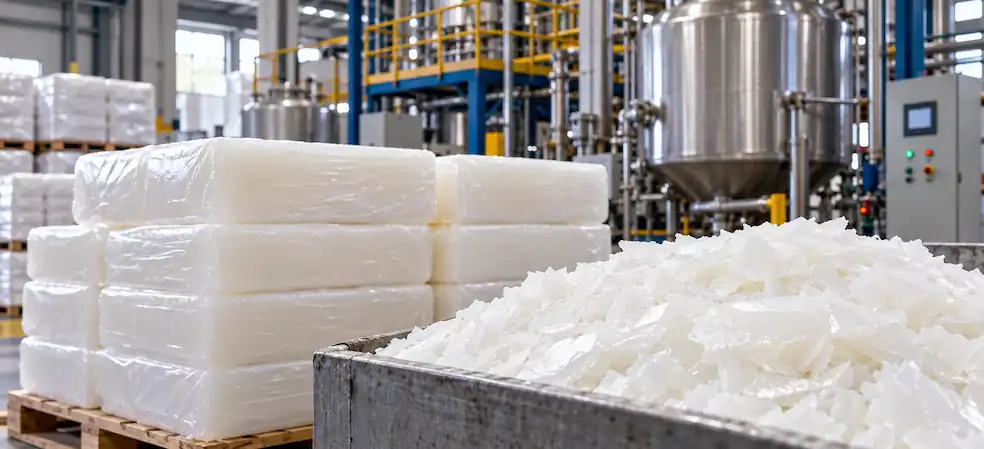
It is generally solid at room temperature and is commonly available in different refining levels and melting ranges.
Commercial paraffin wax may include:
- Fully refined paraffin wax
- Semi-refined paraffin wax
- Less refined wax grades
Paraffin wax is widely used in candles, packaging, rubber, coatings, polishes, adhesives, textiles, and other industrial applications.
Microcrystalline Wax
Microcrystalline wax has a different crystal structure from conventional paraffin wax.
It is generally more flexible, adhesive, and tacky than paraffin wax and often has a higher viscosity.
Typical applications may include:
- Adhesives
- Rubber compounds
- Protective coatings
- Polishes
- Specialty wax blends
- Industrial formulations
Microcrystalline wax is often selected when flexibility, adhesion, or cohesive strength is required.
Slack Wax
Slack wax is an intermediate petroleum wax product that contains a relatively higher percentage of oil.
It is produced during the refining and dewaxing of lubricating oils and may later undergo further processing to produce more refined wax grades.
Slack wax may be used as:
- Feedstock for further refining
- Raw material in selected industrial formulations
- Component in wax blends
- Input material for paraffin wax production
Its exact properties depend strongly on its oil content and production source.
Petrolatum
Petrolatum is a semi-solid petroleum-derived material with a softer consistency than conventional solid paraffin wax.
It is used in applications where flexibility, moisture resistance, lubrication, or protective properties are required.
Industrial applications can include:
- Protective coatings
- Lubrication
- Specialty formulations
- Industrial compounds
The required grade depends on the intended use and technical specification.
Key Properties of Petroleum Wax
When purchasing petroleum wax, industrial buyers should evaluate the technical properties of the specific grade rather than relying only on the product name.
Melting Point
Melting point indicates the temperature range at which the wax changes from solid to liquid.
It influences:
- Processing temperature
- Heat resistance
- Cooling behavior
- Finished-product stability
- Storage requirements
Different manufacturing applications may require different melting ranges.
Oil Content
Oil content represents the amount of residual oil remaining in the wax.
It can affect:
- Hardness
- Flexibility
- Surface feel
- Tack
- Appearance
- Processing behavior
- Finished-product performance
Highly refined wax grades generally contain less residual oil than less refined grades.
Penetration
Penetration is commonly used to evaluate wax hardness or consistency under controlled test conditions.
Lower penetration = harder wax
Higher penetration = softer wax
This property can be important in applications where rigidity or surface resistance is required.
Viscosity
Viscosity describes the flow behavior of molten wax.
It can influence processes such as:
- Pumping
- Mixing
- Filling
- Coating
- Spraying
- Dipping
- Blending
Manufacturers should evaluate viscosity at the relevant processing temperature.
Color
Color can be particularly important when the wax remains visible in the final product.
More highly refined wax grades generally have a cleaner and brighter appearance.
Color requirements may be especially important in:
- Candles
- Polishes
- White formulations
- Decorative products
- Coatings
Congealing Point
The congealing point describes the temperature at which molten wax begins to solidify under specified test conditions.
It can help manufacturers understand cooling and solidification behavior during production.
Why Petroleum Wax Properties Matter
Two petroleum wax products may look similar but behave differently during manufacturing.
For example, differences in melting point, oil content, hardness, and viscosity can affect:
- Equipment temperature settings
- Mixing behavior
- Cooling time
- Surface finish
- Product rigidity
- Coating performance
- Finished-product stability
For this reason, wax selection should always be based on the complete technical specification.
Industrial Applications of Petroleum Wax
Candle Manufacturing
Paraffin wax is widely used in candle production because of its controlled melting behavior, availability, and ability to form stable solid products.
Manufacturers may select different grades according to:
- Candle type
- Required hardness
- Ambient temperature
- Fragrance loading
- Production process
- Desired surface appearance
Packaging Industry
Wax can be used in packaging and coating applications to improve characteristics such as:
- Moisture resistance
- Surface protection
- Barrier performance
- Gloss
- Handling characteristics
The selected grade depends on the substrate and required performance.
Rubber Industry
Petroleum waxes can be incorporated into rubber formulations for specific processing or protective functions.
Wax selection may depend on:
- Melting range
- Compatibility
- Migration characteristics
- Hardness
- Required surface protection
Coatings
Wax can modify the surface properties of coatings.
Depending on the formulation, it may contribute to:
- Water resistance
- Slip
- Gloss control
- Surface protection
- Abrasion characteristics
Polishes
Petroleum wax is widely used in industrial and consumer polish formulations.
It can influence:
- Hardness
- Gloss
- Surface protection
- Buffing characteristics
- Water resistance
Adhesives
Wax is used in some adhesive formulations to modify properties such as:
- Viscosity
- Setting behavior
- Open time
- Processing temperature
- Finished hardness
The type and quantity of wax depend on the adhesive system.
Textile Applications
Wax may be used in selected textile-processing operations where lubrication, surface treatment, or processing assistance is required.
The appropriate grade depends on the manufacturing process and required finished-product characteristics.
Paper and Board
Wax coatings may be used in paper and board applications where moisture resistance or surface protection is required.
Different wax grades can affect coating behavior and finished performance.
Industrial Wax Blends
Petroleum waxes are frequently blended with other materials to create formulations with specific properties.
A manufacturer may combine waxes to adjust:
- Melting range
- Hardness
- Flexibility
- Adhesion
- Viscosity
- Surface characteristics
MNF Petroleum Wax Grades
Among petroleum wax products, paraffin wax remains one of the most important for industrial manufacturing.
The performance of paraffin wax depends strongly on its refining level and technical specification.
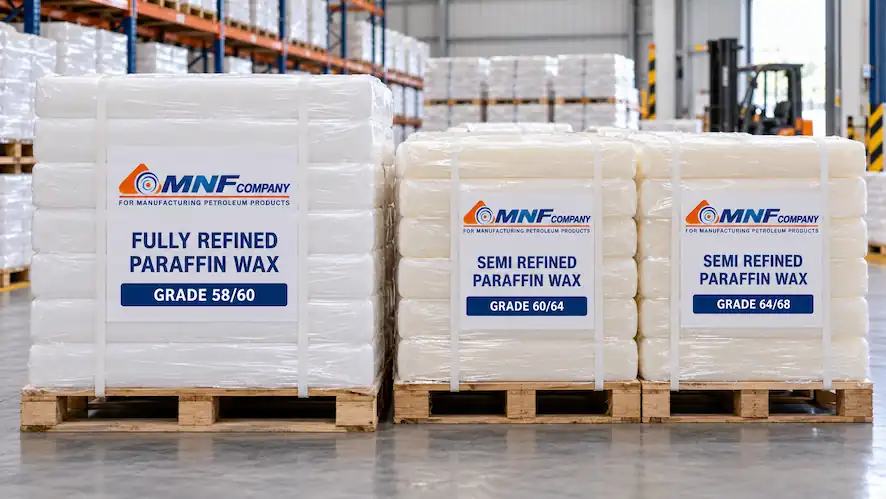
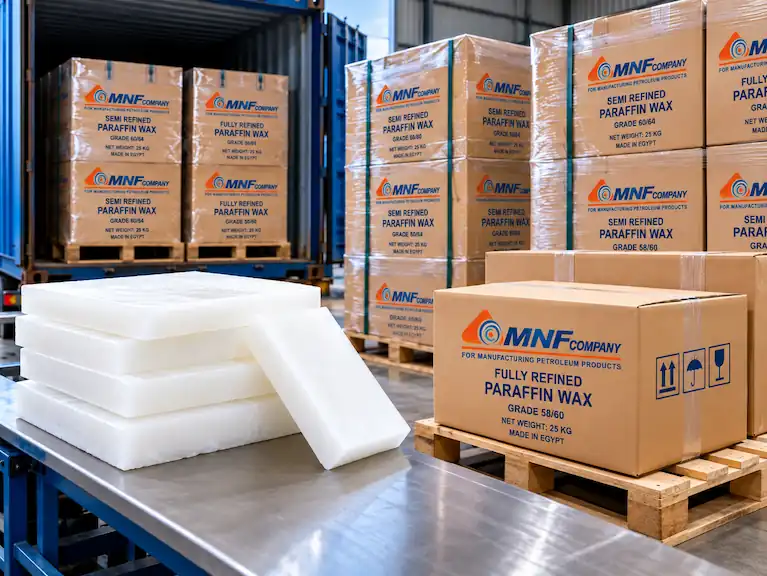
MNF manufactures both fully refined and semi-refined paraffin wax grades.
MNF Fully Refined Paraffin Wax 58–60°C
MNF manufactures Fully Refined Paraffin Wax Grade 58–60°C.
This grade provides a controlled melting range and is intended for industrial applications that may require characteristics such as:
- Clean appearance
- Consistent processing behavior
- Good hardness
- Refined product quality
- Controlled melting characteristics
MNF Semi-Refined Paraffin Wax 60–64°C
MNF also manufactures Semi-Refined Paraffin Wax Grade 60–64°C.
Its documented target specification includes:
- Melting Point: 60–64°C
- Oil Content: 2.0–4.0%
- Saybolt Color: +17 minimum
- Viscosity at 100°C: 5.0–5.8 cSt
- Penetration at 25°C: 20–25
- Congealing Point: 58–62°C
MNF Semi-Refined Paraffin Wax 64–68°C
MNF manufactures Semi-Refined Paraffin Wax Grade 64–68°C for applications requiring a higher melting range.
Its documented target specification includes:
- Melting Point: 64–68°C
- Oil Content: 2.0–4.0%
- Saybolt Color: +19 minimum
- Viscosity at 100°C: 5.3–6.2 cSt
- Penetration at 25°C: 15–20
- Congealing Point: 62–66°C
How to Select the Right Petroleum Wax
1. Application
Determine exactly what function the wax needs to perform.
2. Melting Range
The selected melting range must be compatible with processing temperatures and finished-product requirements.
3. Oil Content
Oil content can influence hardness, flexibility, surface characteristics, and processing behavior.
4. Hardness
Penetration values can help buyers compare wax consistency.
5. Viscosity
Molten viscosity is important when the wax will be pumped, sprayed, coated, mixed, or filled.
6. Color
Appearance-sensitive applications may require a brighter and more highly refined wax.
7. Packaging
Industrial buyers should confirm how the wax will be packed and handled throughout transport and storage.
8. Storage Conditions
Wax should be stored according to supplier recommendations in suitable industrial conditions to protect product quality.
9. Transportation Requirements
The required packaging and shipping method should be selected according to order volume, destination, and handling requirements.
Technical Data Sheet and Certificate of Analysis
Technical Data Sheet — TDS
The Technical Data Sheet describes the target product specification.
It may include:
- Melting point
- Oil content
- Penetration
- Viscosity
- Color
- Congealing point
Certificate of Analysis — COA
The Certificate of Analysis provides laboratory results for a specific production batch.
TDS = target specification
COA = actual batch test results
These documents help buyers verify whether the product meets their technical requirements.
Petroleum Wax Quality and Consistency
For industrial users, consistency between batches is important.
Variations in key properties can influence production settings and finished-product quality.
Important factors to monitor include:
- Melting range
- Oil content
- Hardness
- Color
- Viscosity
- Physical appearance
Frequently Asked Questions About Petroleum Wax
What is petroleum wax?
Petroleum wax is a category of wax materials obtained during petroleum refining. It includes products such as paraffin wax, microcrystalline wax, slack wax, and petrolatum.
Is paraffin wax a petroleum wax?
Yes. Paraffin wax is one of the most widely used types of petroleum wax.
What is petroleum wax used for?
Petroleum wax is used in candles, packaging, rubber, coatings, adhesives, polishes, textiles, paper, board, industrial blends, and many other manufacturing applications.
What properties should I check before buying petroleum wax?
Important properties can include melting point, oil content, penetration, viscosity, color, congealing point, and physical appearance.
What petroleum wax products does MNF manufacture?
MNF manufactures Fully Refined Paraffin Wax Grade 58–60°C and Semi-Refined Paraffin Wax grades 60–64°C and 64–68°C.
What documents should industrial buyers request?
Buyers should review the applicable Technical Data Sheet and Certificate of Analysis when evaluating a product grade.
Choosing Petroleum Wax for Industrial Manufacturing
Selecting petroleum wax should be based on technical performance rather than product name alone.
The most important factors include wax type, refining level, melting range, oil content, hardness, viscosity, and application requirements.
Understanding these properties helps manufacturers choose a wax grade that fits their equipment, production conditions, and finished-product requirements.
MNF manufactures fully refined and semi-refined paraffin wax grades for industrial customers.
Contact MNF with your required application, grade, quantity, and destination to discuss product specifications and commercial requirements.