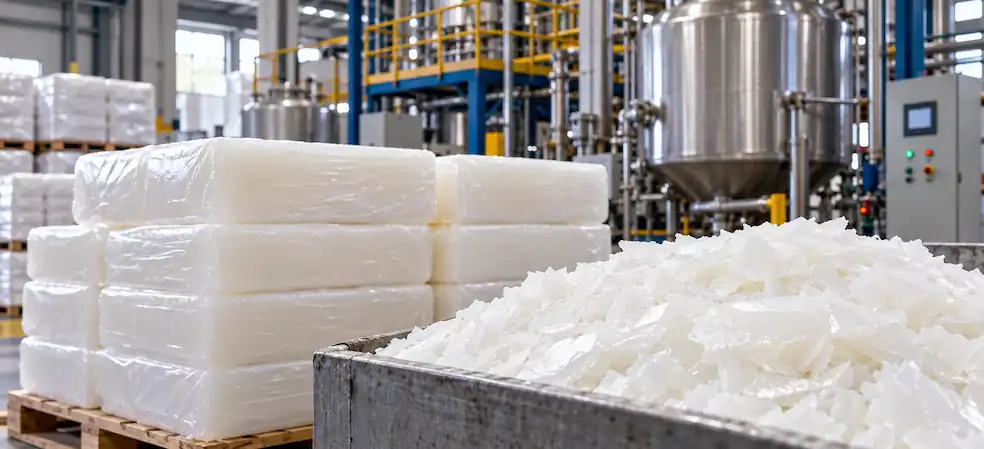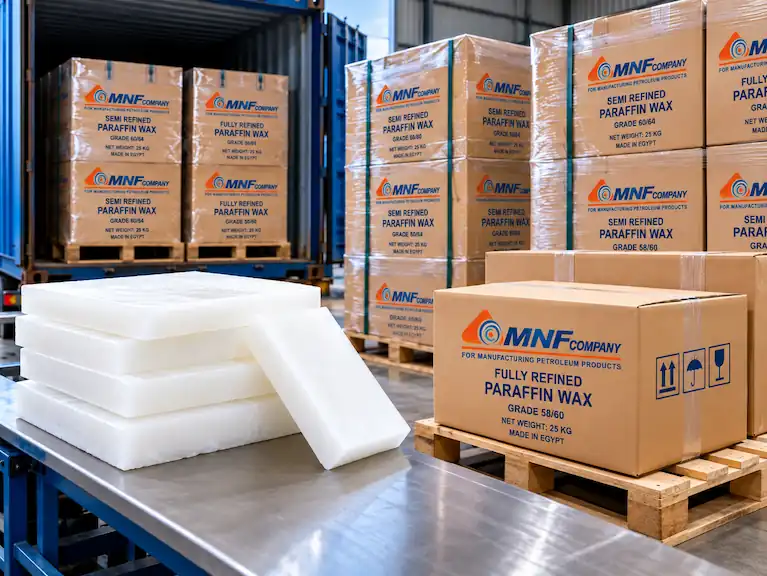
Paraffin wax is used across a wide range of industries, including candle manufacturing, packaging, rubber, coatings, polishes, adhesives, textiles, and other industrial applications.
However, not all paraffin wax grades are the same.
Two of the most common commercial categories are fully refined paraffin wax and semi-refined paraffin wax.
Although both originate from petroleum-refining processes, differences in refining level, residual oil content, color, hardness, and other physical properties can influence how each grade performs in manufacturing.
For industrial buyers, choosing the right paraffin wax should be based on the technical requirements of the application, not simply on the name of the grade.
Types of Paraffin Wax: Fully Refined and Semi-Refined
Paraffin wax is a petroleum-derived solid wax composed mainly of saturated hydrocarbons.
At room temperature, it is typically solid and can range in appearance from bright white to slightly off-white depending on the grade, refining level, and oil content.
Commercial paraffin wax is commonly evaluated according to properties such as:
- Melting point
- Oil content
- Penetration
- Viscosity
- Color
- Congealing point
- Physical appearance
These specifications help manufacturers determine whether a particular grade is suitable for their production process.
Main Types of Paraffin Wax
Paraffin wax can be supplied in several levels of refining.
For many industrial buyers, the two most important categories are fully refined paraffin wax and semi-refined paraffin wax.
Fully Refined Paraffin Wax
Fully refined paraffin wax undergoes a higher degree of refining and deoiling.
It is generally characterized by:
- Cleaner and brighter appearance
- Lower residual oil content
- Good hardness
- Controlled melting behavior
- Consistent physical properties
- Low odor
- Good surface appearance
Because of these characteristics, fully refined paraffin wax is often selected for applications where appearance, consistency, or lower oil content are particularly important.
Semi-Refined Paraffin Wax
Semi-refined paraffin wax undergoes less extensive refining than fully refined wax and typically retains more residual oil.
It can still provide excellent performance in many industrial applications where extremely low oil content is not required.
Semi-refined paraffin wax is commonly used in applications such as:
- Candles
- Rubber
- Packaging
- Coatings
- Polishes
- Textile processing
- General industrial formulations
Its performance depends strongly on the exact grade and technical specification.
Fully Refined vs Semi-Refined Paraffin Wax
The main difference is not simply appearance.
The refining level can influence several important properties.
| Property | Fully Refined Paraffin Wax | Semi-Refined Paraffin Wax |
|---|---|---|
| Refining level | Higher | Moderate |
| Residual oil | Generally lower | Generally higher |
| Appearance | Usually brighter white | White to slightly off-white |
| Odor | Typically lower | May be slightly more noticeable depending on grade |
| Hardness | Generally high | Depends on grade and oil content |
| Surface finish | Cleaner and more uniform | May vary according to specification |
| Typical selection factor | Purity and appearance | Cost-performance and industrial suitability |
These are general distinctions.
The final purchasing decision should always be based on the actual Technical Data Sheet and Certificate of Analysis for the product.
Why Oil Content Matters in Different Types of Paraffin Wax
Oil content is one of the most important differences between paraffin wax grades.
Residual oil can influence hardness, flexibility, surface feel, tack, appearance, processing behavior, and finished-product performance.
A lower-oil wax is generally harder and cleaner in appearance, while a wax with higher residual oil may offer different flexibility and processing characteristics.
This does not mean that lower oil content is always better. The correct oil level depends on what the wax needs to do in the final application.
ASTM D721 is commonly used to determine the oil content of petroleum waxes and is relevant when evaluating how residual oil may affect physical properties.
Learn more about ASTM D721 for petroleum wax oil content.
MNF’s current semi-refined paraffin wax grades are specified with an oil content of 2.0–4.0%.
Why Melting Point Matters in Paraffin Wax Grades
Paraffin wax is commonly sold according to a melting range.
The melting range affects:
- Processing temperature
- Heat resistance
- Cooling behavior
- Finished-product stability
- Storage and handling conditions
A higher-melting wax may be preferred when greater thermal resistance or hardness is required, while a lower-melting grade may be easier to process at lower temperatures.
ASTM D87 is a commonly used test method for determining the melting point of petroleum wax by cooling curve.
View ASTM D87 for petroleum wax melting point testing.
MNF’s current paraffin wax portfolio includes melting ranges of:
- 58–60°C
- 60–64°C
- 64–68°C
Each grade is designed to meet different processing and application requirements.
MNF Paraffin Wax Grades
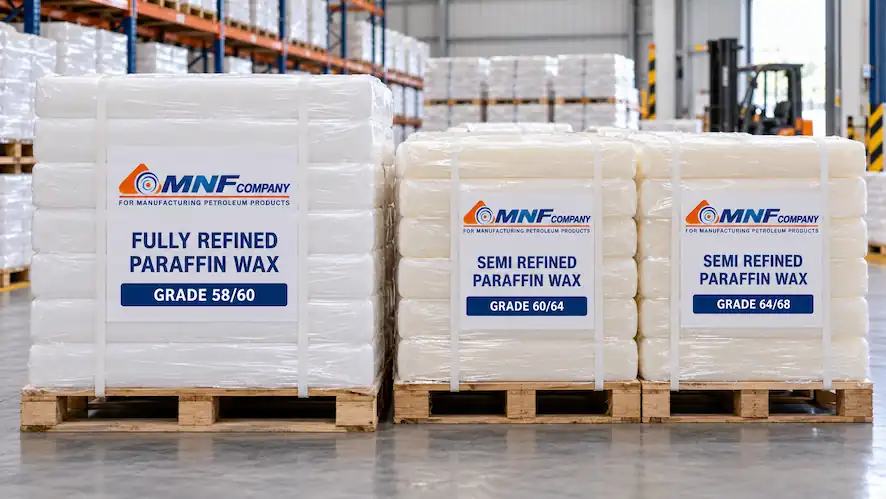
MNF currently manufactures fully refined and semi-refined paraffin wax grades for industrial applications.
MNF Fully Refined Paraffin Wax 58–60°C
MNF manufactures
Fully Refined Paraffin Wax Grade 58–60°C
for industrial applications requiring a refined paraffin wax with a controlled melting range.
The current product specification includes:
- Melting Point: 58–60°C
- Oil Content: 0.5–1.0%
- Saybolt Color: +25
- Viscosity at 100°C: 4–6 cSt
- Penetration: 15–19
- Congealing Point: 56°C
This grade is intended for applications where manufacturers may require characteristics such as clean appearance, consistent melting behavior, good hardness, and refined product quality.
MNF Semi-Refined Paraffin Wax 60–64°C
MNF also manufactures
Semi-Refined Paraffin Wax Grade 60–64°C
.
Its current target specification includes:
- Melting Point: 60–64°C
- Oil Content: 2.0–4.0%
- Color: ASTM D1500, 0.5
- Viscosity at 100°C: 5.0–5.8 cSt
- Penetration at 25°C: 20–25
- Congealing Point: 58–62°C
This combination of properties can make the grade suitable for manufacturers looking for a balance between hardness, melting behavior, and industrial processing characteristics.
MNF Semi-Refined Paraffin Wax 64–68°C
For applications requiring a higher melting range, MNF manufactures
Semi-Refined Paraffin Wax Grade 64–68°C
.
Its current target specification includes:
- Melting Point: 64–68°C
- Oil Content: 2.0–4.0%
- Color: ASTM D1500, 0.5
- Viscosity at 100°C: 5.3–6.2 cSt
- Penetration at 25°C: 15–20
- Congealing Point: 62–66°C
Compared with the 60–64°C grade, this product offers a higher melting range and lower penetration values, which indicate a harder wax under comparable test conditions.
You can also explore the complete MNF paraffin wax product range.
How Refining Affects Paraffin Wax Color
Paraffin wax appearance can range from bright white to slightly off-white depending on the degree of refining and other product characteristics.
Fully refined wax is generally expected to have a cleaner, brighter appearance.
Semi-refined wax may still appear white but can sometimes have a slightly warmer or cream-colored tone.
Color requirements can be important for applications where the wax remains visible in the finished product.
Examples include:
- Decorative candles
- Polishes
- Coated surfaces
- White or light-colored formulations
For these applications, buyers should compare the actual color specification rather than relying only on visual appearance.
What Does Penetration Mean?
Penetration is used to evaluate wax consistency or hardness under controlled test conditions.
Lower penetration = harder wax
Higher penetration = softer wax
This property can be important when wax is used in products where rigidity, flexibility, or surface resistance matters.
For example, MNF’s Semi-Refined Paraffin Wax 64–68°C has a lower target penetration range than the 60–64°C grade.
This is consistent with the higher-melting grade being harder under the specified test conditions.
What Does Viscosity Mean?
Viscosity describes how easily molten wax flows.
It can affect industrial processes such as:
- Pumping
- Mixing
- Coating
- Spraying
- Dipping
- Filling
- Blending
A wax with suitable viscosity can help manufacturers maintain predictable processing conditions.
Viscosity should therefore be considered together with melting point, oil content, and application temperature.
Fully Refined Paraffin Wax Applications
Fully refined paraffin wax may be suitable for applications where a cleaner and more highly refined wax is preferred.
Typical applications can include:
- Candle manufacturing
- Coatings
- Polishes
- Packaging
- Adhesive formulations
- Textile applications
- Industrial wax blends
- Other appearance-sensitive products
The exact grade should always be matched to the manufacturing process.
Semi-Refined Paraffin Wax Applications
Semi-refined paraffin wax is widely used in industrial applications where its balance of physical properties and residual oil content is suitable.
Applications may include:
- Candle manufacturing
- Rubber
- Packaging
- Paper and board
- Coatings
- Polishes
- Textile processing
- Industrial formulations
Different semi-refined grades may perform differently because of differences in melting range, hardness, viscosity, and other properties.
How to Choose the Right Paraffin Wax Grade
There is no single paraffin wax grade that is best for every application.
1. Melting Range
Choose a melting range suitable for the operating temperature and required thermal performance.
2. Oil Content
Determine how much residual oil the formulation can tolerate.
3. Hardness
Compare penetration values when product rigidity or consistency is important.
4. Viscosity
Consider molten flow behavior when the wax will be pumped, coated, sprayed, or mixed.
5. Color
For visible applications, confirm the required color specification.
6. Finished Product Requirements
Consider what the wax needs to achieve in the final formulation.
7. Processing Conditions
Evaluate the temperatures, equipment, and manufacturing methods used in production.
TDS vs COA: What Should Buyers Check?
Industrial buyers should understand the difference between a Technical Data Sheet and a Certificate of Analysis.
Technical Data Sheet — TDS
A TDS describes the target specification of the product.
It may include:
- Melting point
- Oil content
- Viscosity
- Penetration
- Color
- Congealing point
Certificate of Analysis — COA
A COA reports the actual laboratory test results for a specific production batch.
TDS = target specification
COA = actual batch results
For industrial purchasing, both documents can be important.
Fully Refined or Semi-Refined: Which Is Better?
Neither category is automatically better.
The correct choice depends on the intended application.
A fully refined paraffin wax may be preferred when:
- Lower residual oil is important
- Appearance is critical
- A more highly refined wax is required
- Cleaner surface characteristics are preferred
A semi-refined paraffin wax may be suitable when:
- The application allows higher residual oil
- Industrial performance is the main requirement
- The selected specification matches the process
- A balance between properties and commercial requirements is needed
The best decision should be based on technical compatibility, not only the refining label.
Frequently Asked Questions About Types of Paraffin Wax
What is the difference between fully refined and semi-refined paraffin wax?
Fully refined paraffin wax undergoes more extensive refining and generally contains less residual oil. Semi-refined wax retains a higher oil content and can offer suitable performance for many industrial applications.
Is fully refined paraffin wax always better?
No. The correct grade depends on the application. A semi-refined grade may be more appropriate when its melting range, oil content, hardness, and other properties match the manufacturing process.
What does 58–60°C mean in paraffin wax?
It refers to the specified melting range of the wax.
What does oil content mean in paraffin wax?
Oil content represents the residual oil remaining in the wax after refining and deoiling. It can affect hardness, flexibility, appearance, and processing behavior.
Which MNF paraffin wax grades are available?
MNF currently manufactures Fully Refined Paraffin Wax 58–60°C, Semi-Refined Paraffin Wax 60–64°C, and Semi-Refined Paraffin Wax 64–68°C.
What documents should I request before ordering?
Industrial buyers should typically review the relevant Technical Data Sheet and request the Certificate of Analysis for the supplied batch.
Choosing the Right Type of Paraffin Wax
Understanding the different types of paraffin wax helps industrial buyers compare refining level, melting range, oil content, hardness, viscosity, and color before selecting a grade.
The difference between fully refined and semi-refined paraffin wax goes beyond the product name.
The most important purchasing factors include refining level, melting range, oil content, hardness, viscosity, color, and application requirements.
Understanding these specifications allows industrial buyers to select a wax that performs reliably within their manufacturing process.
If you need help selecting the right grade for your application, contact MNF with your required melting range, quantity, application, and destination.
MNF manufactures both fully refined and semi-refined paraffin wax grades for industrial customers.